How Reverse Osmosis Removes Dangerous Contaminants from Water – A Scientific Explanation
In recent years, more and more households are choosing to install a water purification system based on reverse osmosis (RO). The reason is simple: when it comes to the quality of the water we drink every day, there is no room for compromise. But what exactly does reverse osmosis do? How does it work? And most importantly – how does it remove dangerous contaminants from water?
This blog post will explain the scientific basis of reverse osmosis, its effectiveness, and why it represents one of the best solutions for clean and safe water in the home.
What is reverse osmosis?
Reverse osmosis (RO) is a water purification technology that uses a semi-permeable membrane to remove up to 99% of contaminants present in water. Unlike ordinary filters, RO not only improves the taste and odour of water, but physically eliminates even the smallest harmful particles, including:
- Heavy metals (lead, mercury, arsenic)
- Nitrates and nitrites
- Chlorine and chlorine by-products
- Microorganisms (bacteria, viruses)
- Fluoride, sulphates and phosphates
- Pharmaceutical residues and microplastics
How the process works – from a scientific perspective
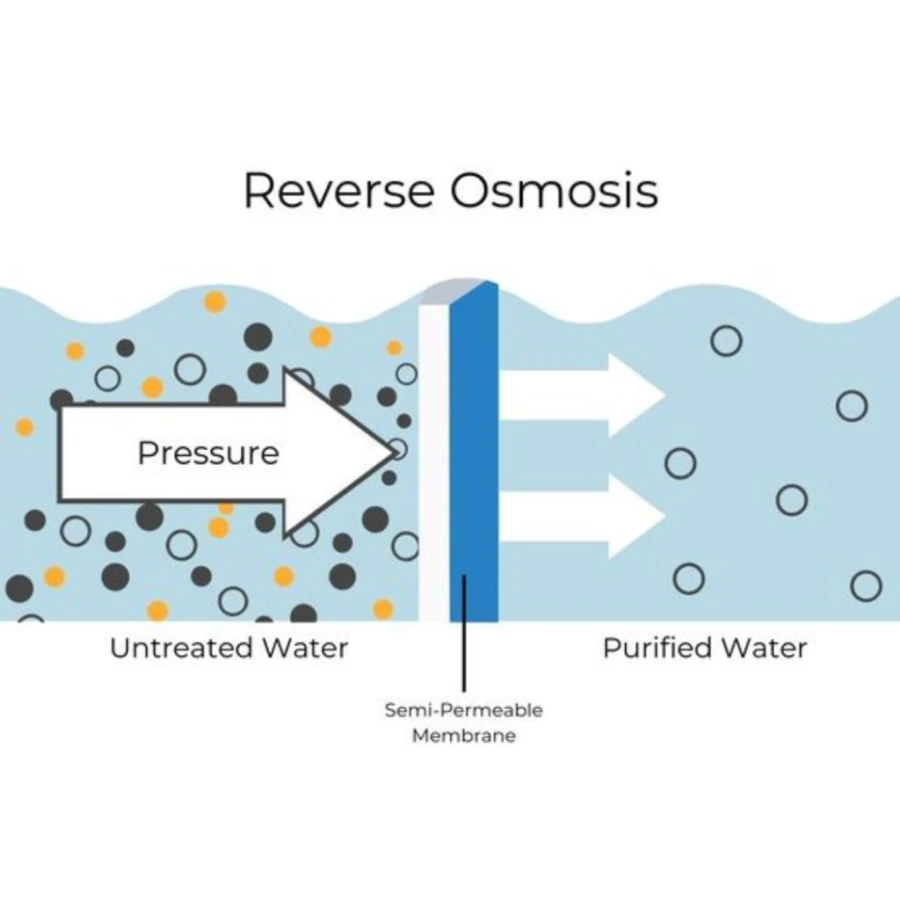
In nature, osmosis is a process in which water molecules pass through a semi-permeable membrane from an area of lower salt concentration towards an area of higher concentration. In reverse osmosis, this direction is "reversed" by applying pressure.
The system works as follows:
- Mains water pressure is used to force water through the RO membrane.
- The membrane has pores approximately 0.0001 microns in size, meaning it retains virtually all dissolved solids, bacteria and organic contaminants.
- Only pure water molecules (H₂O) manage to pass through, while contaminants are separated and discharged into the drain line.
Which contaminants does reverse osmosis remove?
Here is a list of some of the most dangerous contaminants that RO technology eliminates:
1. Lead and other heavy metals
Lead is a neurotoxin that causes damage to the nervous system, especially in children. The RO membrane retains particles of lead, copper, mercury and arsenic.
2. Chlorine and its by-products (THMs)
Although chlorine is used for disinfection, its by-products – trihalomethanes (THMs) – are carcinogenic. A multi-stage filter system (including activated carbon) combined with the RO membrane removes these substances.
3. Nitrates and nitrites
Particularly dangerous for infants and young children, as they reduce the capacity of the blood to carry oxygen. The RO membrane eliminates these compounds almost entirely.
4. Fluoride
Although fluoride is often added to water for dental health, excessive exposure can lead to fluorosis and other health problems. RO is one of the few technologies that effectively removes fluoride.
5. Bacteria and viruses
While some systems also use UV lamps for additional protection, the RO membrane itself can retain many microorganisms due to its extremely fine structure.
6. Pharmaceutical residues and hormones
These are increasingly found in water due to improper disposal of medicines. RO systems demonstrate high effectiveness in this category as well.
What does a 6 or 7 stage RO system include?
The systems offered by Spar Company feature 6 or 7 levels of filtration, making them particularly effective and reliable. Here is a brief overview:
- Sediment filter (first stage) – removes coarse particles: sand, rust.
- Activated carbon (second and third stage) – removes chlorine content, bad odour and chemicals.
- RO membrane (fourth stage) – the heart of the system: eliminates virtually all dissolved salts, bacteria and viruses.
- Post-carbon filter (fifth stage) – improves the taste and purity of the water.
- Mineral filter (sixth stage) – re-mineralization of the water with natural minerals such as calcium and magnesium.
- Alkaline filter or UV sterilisation (seventh stage) – further improves the pH value or performs sterilisation.
Why choose reverse osmosis over other solutions?
- Multi-layered protection against a wide variety of contaminants
- Consistent water quality, independent of the condition of the mains network
- The ideal solution for infants, children and people with a sensitive immune system
- Long-term savings, since you no longer buy bottled water and avoid potential health costs
Conclusion
Reverse osmosis is not merely a "filter" – it is a sophisticated water purification system based on advanced scientific technology. With the ability to remove over 90–99% of the most dangerous contaminants, RO is the safest option for families who want impeccably clean, healthy and safe water every day.
If you would like more information or wish to receive advice on choosing the right RO system for your home, the team at Spar Company is here to help. Contact: 076 676 819 | 070 755 190